
Alamance Detention Release Routes
A release from the Alamance County Detention Center is an event tied to one booking. It does not always mean freedom from all custody. Someone may leave on a secured or unsecured bond, a written promise, after dismissal, for time served, at the end of a local sentence, or under another court order. Those routes normally return the person to the community. The Sheriff’s Office can confirm when its custody ended, while the Clerk of Superior Court holds the order or judgment that supplies the legal basis.
Other departures are transfers. A person may go to the North Carolina Department of Adult Correction, another county jail, federal authorities, or immigration custody. The receiving authority becomes the next source. An internal move between the main buildings and the Annex is neither a transfer out nor a release. Ask for the release type, receiving agency, and effective date instead of relying on a missing name in the public roster.
| Departure | Where to confirm it |
|---|---|
| Bond, time served, or court release | Detention Center release record plus the Alamance court case |
| Move to the Annex | ACSO housing information; custody continues |
| Commitment to state prison | NC DAC Offender Public Information |
| Another county or federal custodian | ACSO receiving-agency field, then that custodian |
| Possible ICE handoff | ACSO confirmation and the official ICE locator |
Confirm an Alamance Jail Release
The ACSO P2C Inmate Inquiry is the right first check for a current county booking. Its entry page is a live inmate inquiry, not a historical release archive. Public detail can show the arrest date, bond, next court date, photograph, and a release-date label, but field presence varies. No official post-release display period is published. A no-result cannot prove release.
- Search the exact name in P2C and compare age, booking agency, arrest date, and charge. Save the booking number while the record is visible.
- Open the detail and note the release-date field, bond, and next court date. Treat a bond amount as a lead, not proof that release processing finished.
- Call the Detention Center at (336) 570-6317. Give the booking number and ask whether the event was community release, transfer, or an internal housing move.
- Match the case in North Carolina eCourts or ask the Alamance Clerk for the order, dismissal, judgment, or bond change.
- If ACSO names DAC or another receiving authority, confirm the next custody event in that system. NC SAVAN through VINELink can provide a second status check.
A released person usually leaves the current jail roster. Absence alone cannot distinguish community release, transfer, a spelling mismatch, or a delayed system update.
The full county release-search and records sequence is set out on the Alamance County released inmates search. Use it when the P2C detail is gone or the destination remains unclear.
Alamance Release Records Contact
ACSO says public-record requests must be made in writing because of request volume. The official public-records page links to its written request form. Identify one booking episode and request existing fields rather than asking staff to conduct broad research. Useful identifiers include the full name, booking number, arrest date, and approximate release date.
Alamance County Detention Center109 S. Maple Street
Graham, NC 27253
Phone: (336) 570-6317
Email: DetentionAdmin@alamancecountync.gov
Front office: Monday through Friday, 8:00 a.m. to 5:00 p.m., except holidays
Ask for the admission date and time, release date and time, release reason or code, bond information recorded for that booking, and any releasing or receiving authority. The ACSO written public-record request form includes a description field and warns that a request will not be interpreted beyond its face. A narrow request helps the custodian locate the right episode and avoid a same-name error.
North Carolina General Statutes Chapter 132 governs access. Ordinary uncertified copies may be charged at actual reproduction cost unless another law applies. Extensive requests can produce a special service charge. No ACSO release-sheet price was verified, so request a written estimate before work begins and ask for electronic delivery when it will meet the need.
Alamance Detention Center Capacity
The official Detention Center description identifies a county jail run by the Alamance County Sheriff’s Office. The main complex includes 156 beds in the original facility and 240 beds in an addition that opened in 2007. The separate Annex has 80 more beds. Together, the sheriff describes a 476-bed detention operation staffed across four platoons, support, facilities and maintenance, and administration.
The sheriff’s facility page is shown in the image below. It ties the capacity figures to the operating agency and provides the official contact used for release confirmation.
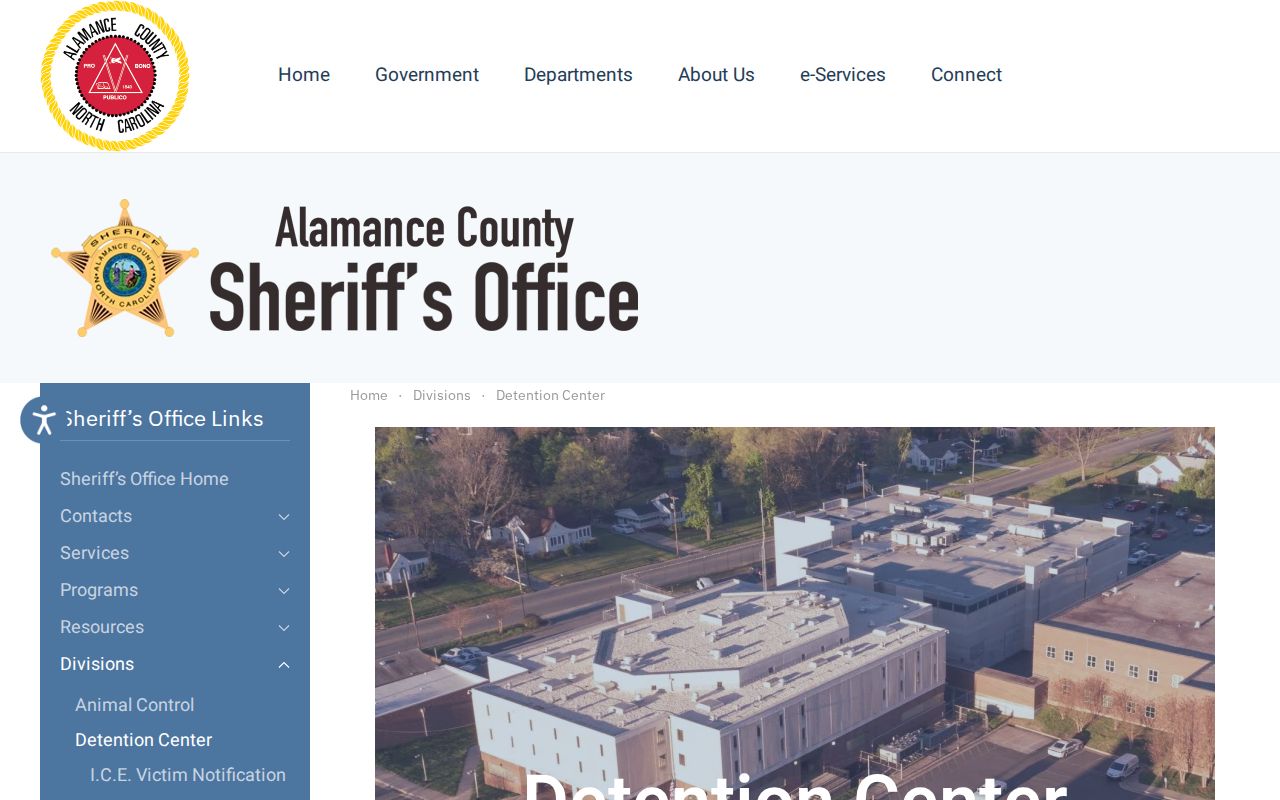
The multiple buildings matter because housing changes can look like movement in records. P2C is one county inquiry system and does not provide a building selector, so location within the complex must come from ACSO.
Alamance Release Record Fields
A jail release record should be read as one custody episode. The person’s identity and booking number anchor the event. Admission data shows when the episode began. Release date and time show when ACSO’s custody ended, while the reason or type explains why. A receiving-agency field can convert what looks like release into a documented transfer.
| Field | What it establishes |
|---|---|
| Booking number | The specific jail episode and safest request identifier |
| Admission date/time | When ACSO custody for that episode began |
| Release date/time | When physical custody at the jail ended |
| Release type or code | Bond, court order, sentence completion, transfer, or another basis |
| Receiving authority | Where custody continued after a transfer |
| Case and bond fields | Links to the court matter and the release conditions recorded at booking |
The court record serves a different role. It can show a dismissal, judgment, release order, bond modification, or other case action. It does not replace the sheriff’s certification of the physical release. Use the same case number and date to reconcile the two.
Alamance Court and Jail Records
The main jail stands close to Graham’s criminal-court functions, but proximity does not merge the records. Criminal matters are handled at the Judge J.B. Allen Jr. Criminal Courthouse. The Clerk can supply a certified court document. ACSO remains the custodian for jail booking, housing, and physical release facts.
- Release
- The end of ACSO custody, which may lead to the community or another custodian.
- Transfer
- A move to a different authority while custody continues.
- Disposition
- The court’s outcome or action in the criminal case.
- Detainer
- A request or legal basis for another authority to take custody.
If a date conflicts, ask each office about the record it controls. A judge may sign an order before jail staff complete identity checks, property return, other-hold review, and physical release. That ordinary gap is why the order time and the release time can differ.
When Alamance Releases Occur
ACSO does not publish a guaranteed release hour, physical pickup door, or weekend and holiday schedule. Detention operations continue around the clock, but the listed front-office schedule is weekday business hours. Families should not assume a court date means a midnight exit or gather at an unconfirmed door.
Call with the booking number. Ask whether all local and outside holds have cleared, whether release is still being processed, and where pickup is allowed. If transportation is needed, Link Transit serves Graham and connects with regional PART service, but published route information does not establish a stop at the jail door. Verify the nearest active stop and operating time directly with the transit system. ACSO has not stated that it provides a ride after release.