
Alamance Federal Release System
No BOP institution is identified in Alamance County. A federal defendant may be arrested locally, held for a short time under an arrangement involving the Alamance County Detention Center, or moved through a contract facility before commitment. Long-term federal placement usually occurs outside the county. The location of confinement does not change the place of arrest or the court handling the federal case.
This distinction controls the records path. ACSO can confirm a county booking and the agency that received the person when local custody ended. BOP controls the public prison history for people committed to its system. USMS manages federal prisoners from arrest through commitment and may control a pretrial detention placement that never becomes a BOP sentence record. A county roster departure to a federal authority is a transfer, not release to the community.
| Custody stage | Primary source |
|---|---|
| Temporary Alamance County jail hold | ACSO booking and release or transfer record |
| Federal pretrial detention | U.S. Marshals district handling the case |
| Committed federal prison term | BOP Inmate Locator and BOP record |
| Federal court outcome | Federal court docket or clerk using the case number |
| Possible immigration custody after release | ICE Online Detainee Locator and field-office channels |
Search a Federal Inmate Release
The BOP Inmate Locator includes federal inmates from 1982 to the present and some older records. An identifying number gives the safest search. BOP accepts a federal register number as well as DCDC, FBI, or INS numbers. A name search can use first, middle, and last name with age, race, and sex to narrow possible matches. Compare more than one field before selecting a record.
- Search by federal register number when it is known. Keep the full number and suffix together.
- If no number is available, enter the exact name and use age, race, and sex only to separate matching results.
- Open the matching result and read the facility and release-date fields in the same row.
- Record the date and time of the search because custody and projected-date information can change.
- If the result shows a past date with no BOP facility, treat it as the end of BOP custody, not proof that every form of custody ended.
- Use the federal case number with the court or USMS when the locator does not cover the person’s detention stage.
The official locator screen is shown below through its BOP source page.
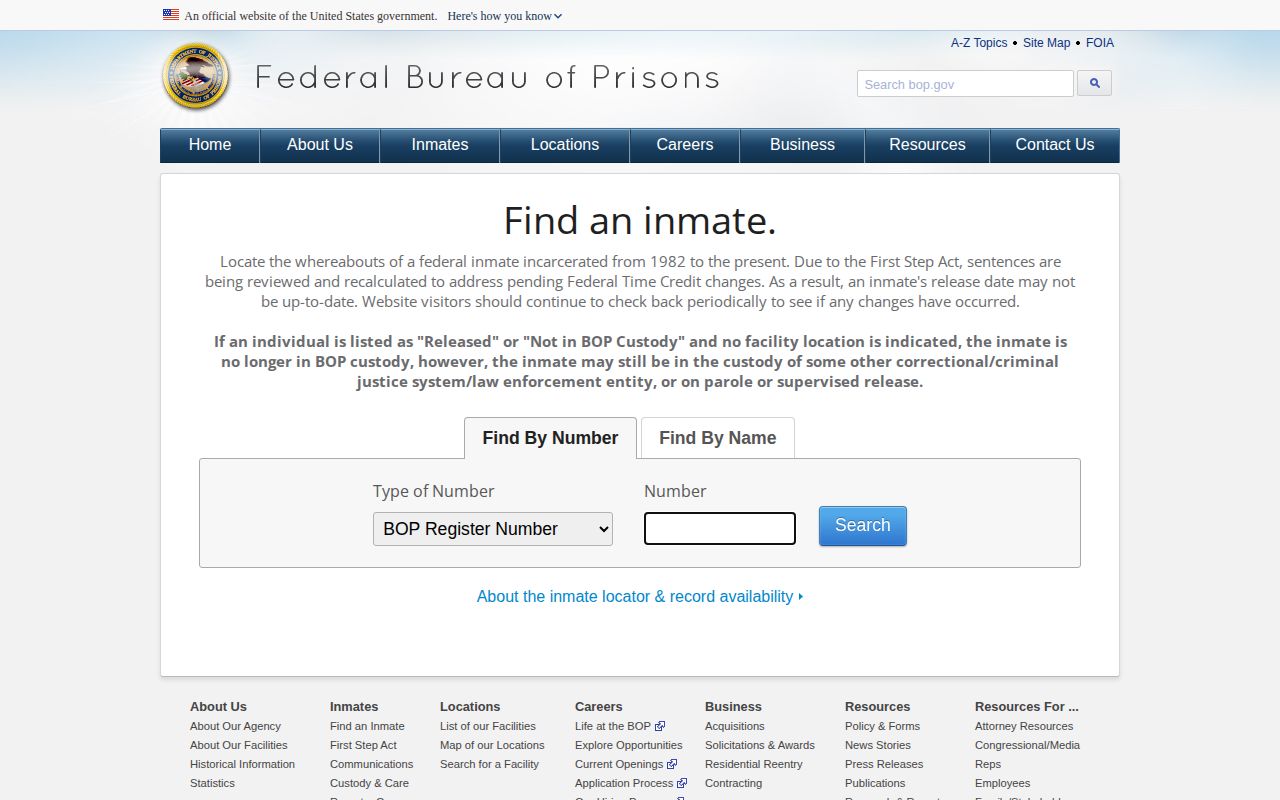
The locator offers both number and name searches. Its result describes BOP custody only, so the record must be paired with the correct court or receiving custodian when the next stage matters.
Read the BOP Release Date
BOP explains that most locator results display a release date. A future date is projected. It is not a promise of the exact hour a person will walk out, and later sentence or administrative events can affect a projection. A past release date with no facility location has a narrower meaning: the person was released from BOP custody on that date according to BOP’s record.
The phrase “not in BOP custody” must stay system-specific. It does not establish release from ACSO, North Carolina DAC, ICE, a state hospital, or USMS pretrial detention. It also does not mean federal supervision ended. Supervised release is a court-ordered period in the community after imprisonment. A person may have left prison while still subject to federal supervision conditions. Parole can also apply in the federal record where legally relevant.
The BOP explanation of locator records supplies the source for interpreting a past release date.
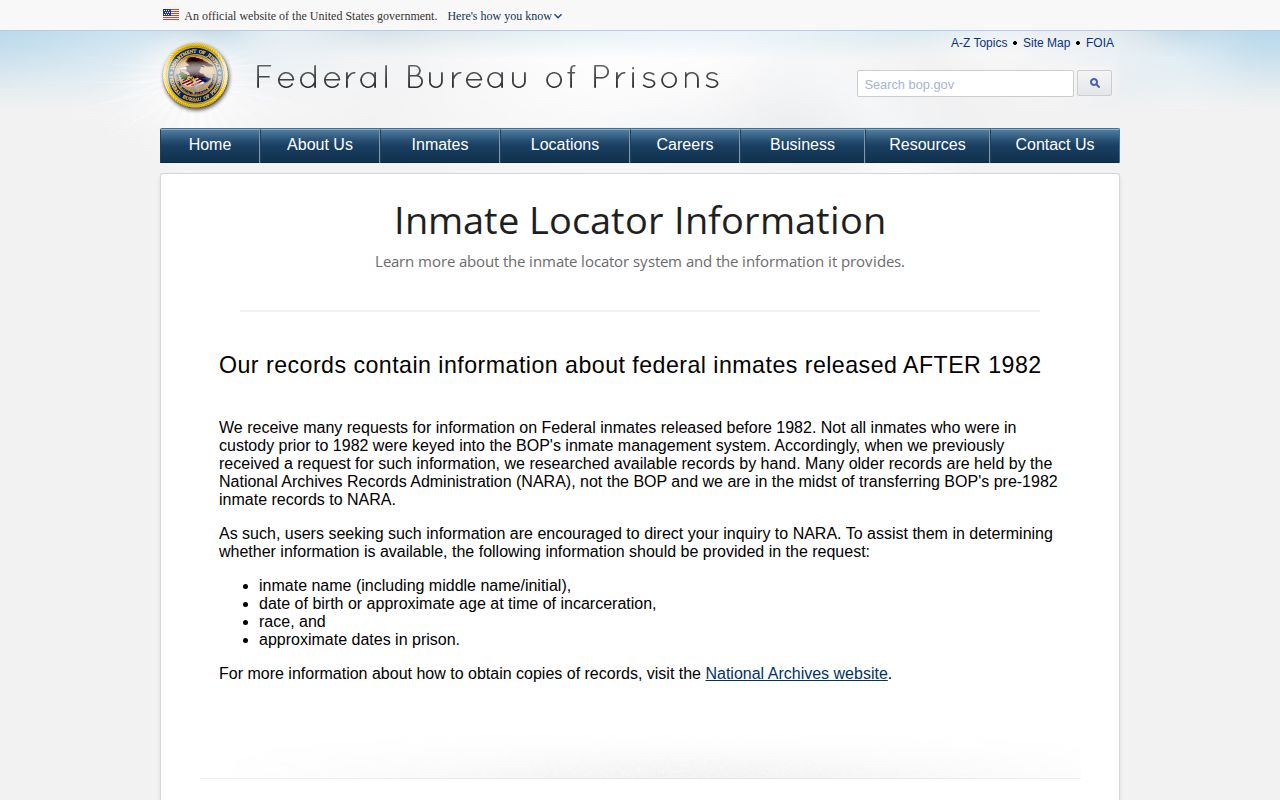
The explanation prevents a common error: a completed BOP prison episode is real, but it does not answer whether another government system holds the person or whether federal supervision continues.
Note: A past BOP release date documents BOP custody ending; it does not certify freedom from every other custodian or supervision term.
USMS Federal Release Limits
The U.S. Marshals Service manages federal prisoners from arrest through commitment. A federal pretrial detainee can be housed in a local jail or contract facility without appearing as a sentenced BOP prisoner. USMS does not offer the same public historical release locator as BOP, and its guidance says location details may be limited for security and operational reasons. A no-result in BOP cannot resolve this stage.
Use the federal case number and contact the district handling the case. The USMS prisoner-information guidance describes the agency’s role and public location limits. If ACSO records show a transfer to USMS, keep the local booking number and ask for the receiving agency and effective transfer date. The federal district can then match the person to the correct case and detention process.
- Pretrial detention
- Custody while the federal case is pending, before a final sentence and BOP commitment.
- Commitment
- The legal transfer of a sentenced federal prisoner into the federal prison system.
- Supervised release
- A court-ordered community supervision term that follows federal imprisonment.
- Transfer
- A change of custodian while detention continues; it is not community release.
Trace an Alamance Federal Release
A person can leave the Alamance County Detention Center on a federal writ or transfer and later return. A writ is a court order requiring the person’s presence or temporary custody for a legal purpose. That movement must not be labeled a community release. Ask ACSO whether the local episode ended, which authority received the person, and whether the event was temporary or final as reflected in the public record.
Start with the county booking number. Request the admission date and time, transfer or release date and time, release type or code, releasing authority, and receiving agency if recorded and public. Then use the federal register number or case number with the next agency. Court docket information explains the legal action, while the custody agency confirms where the person was held.
A departure from Alamance P2C does not prove a federal inmate release. It may record a transfer to USMS or another federal custodian.
The Alamance County released inmate search covers the ACSO record request and court-matching steps needed before the federal lookup begins.
Check Custody After Federal Release
A past BOP date can be followed by state, local, or immigration custody. The BOP locator cannot rule out those systems. If the record or court docket identifies a state detainer, search the named state custodian. For North Carolina custody, use DAC Offender Public Information. If ACSO reports that the person returned to the county jail, use P2C and direct Detention Center confirmation.
ICE custody is another distinct possibility, but it must be based on an agency record, not a name, birthplace, or guess. ICE’s locator uses an A-number with country of birth or a biographical search. Its published scope includes people currently detained and those released from ICE custody within a limited recent window. A no-result outside that scope proves nothing about a prior ICE event.
Use this order of proof: first identify which agency controlled the custody event, then use that agency’s locator or record, and finally compare the court disposition when the legal basis matters. One locator cannot certify a person’s status across all systems.
Federal Release Record Fields
A useful federal release record is tied to one person and one incarceration episode. The register number is the strongest public identifier. The facility and release-date fields describe BOP’s part of the history. Court and supervision information belongs to separate records and should not be inferred from a locator row.
| Field | What it establishes |
|---|---|
| Register or other federal number | The person-level key used to avoid a same-name mismatch |
| Current facility | A BOP location when the person is presently held in that system |
| Future release date | A projected BOP date, not a guaranteed physical exit time |
| Past release date with no facility | The recorded end of BOP custody for that episode |
| Federal case number | The key for the legal docket, judgment, and district contact |
| Receiving custodian | The agency that may hold the person after a transfer |
Preserve the exact result and search date without redistributing unneeded personal information. If the locator conflicts with a court or agency response, ask the custodian of the specific event. BOP controls BOP imprisonment. USMS controls its detention placements. The federal clerk controls the court record. ACSO controls the local county booking and transfer event.
Federal Inmate Release Contacts
There is no local BOP prison office in Alamance County to call for a facility release. Use the national locator and the federal district tied to the case. For a county-to-federal handoff, ACSO remains the local starting point. These routes keep each question with the office that owns the record.
Federal custody lookupBOP Inmate Locator
BOP record and release-date explanation
Federal pretrial custody
U.S. Marshals prisoner information
Use the district and federal case number.
Alamance handoff confirmation
Alamance County Detention Center
109 S. Maple Street, Graham, NC 27253
(336) 570-6317
Ask a narrow question. For BOP, use the register number and incarceration episode. For USMS, use the case number and district. For ACSO, use the county booking number and request the receiving authority. A clear identifier prevents an agency from being asked to certify a record outside its custody.