
Alamance Parole and Probation Types
North Carolina DAC Community Supervision administers probation, parole, and post-release supervision, or PRS. The labels are not interchangeable. Probation usually follows a suspended sentence or community judgment and does not itself prove that someone left prison. PRS begins after release from a modern eligible prison term and remains part of that sentence. Parole is discretionary release for sentence categories that remain parole-eligible.
| Status | How it begins | What it says about release |
|---|---|---|
| Probation | A court orders supervision, often with an active prison term suspended. | It may exist without any state-prison release. |
| Post-release supervision | Statute places an eligible person under supervision after prison. | It confirms prison custody ended, but supervision continues. |
| Parole | The Commission authorizes release for an eligible parole sentence. | It is a prison release with conditions, not a full discharge. |
| Discharge | The sentence or supervision episode ends under its governing authority. | It may mark the end of correctional supervision for that episode. |
The North Carolina Post-Release Supervision and Parole Commission decides parole matters and handles specified PRS actions. Ordinary modern release to PRS is statutory. It should not be reported as a person having “won parole.”
Alamance Supervision Record Terms
A correctional status is a point-in-time agency label. The most recent record may show a community episode after an earlier prison release, or a return to custody after that release. Read the status beside dates and completed episodes instead of treating one word as a full case history.
- Absconder
- DAC alleges the supervised person failed to remain available or comply in a way that led to absconder status. It is not a new conviction.
- Revoked
- Supervision was ended for a violation and custody may have resumed. An earlier release date can still be accurate.
- Detainer
- Another authority has asked to hold or receive a person. A transfer under a detainer is not a community release.
- Discharge
- The supervision or sentence episode ended. The exact record and authority should be checked.
Conditions can include reporting and other Commission or court requirements. Personal reporting schedules and instructions are not necessarily public. Verification should focus on the public status and responsible office, not private case details.
Verify Alamance County Supervision
The DAC Offender Public Information search covers North Carolina prison and community-supervision history. It does not cover every short Alamance County jail booking. An offender number is the most precise search key; a name search requires comparison of identifiers and sentence facts.
- Search the DAC offender number when it is known. Otherwise enter the name and compare age or birth information carefully.
- Open the person page. Do not rely only on the results grid.
- Read the current status, supervision type, dates, county information, and completed incarceration episodes together.
- Use the DAC Community Supervision office directory or the official Alamance numbers to identify the responsible office.
- Call for agency confirmation when a status is unclear, appears delayed, or could refer to an earlier episode.
A released state prisoner can still be under PRS or parole. Conversely, probation does not prove a prison release. For an Alamance jail-only episode, the sheriff release record and court case remain the correct sources. The Alamance County release search sets out that custody-specific path.
Alamance Parole and Probation Contacts
Official Alamance Central Communications listings provide two numbers for probation and parole. Call before visiting because the research did not establish public walk-in hours or a single case-specific street counter. DAC’s directory should be used to confirm the current office arrangement.
North Carolina DAC Community Supervision
Alamance published lines:
(336) 570-6840
(336) 570-6847
State office directory:
Community Supervision offices
Provide the person’s exact name and DAC offender number if known. Ask which office controls the public supervision record and what status can be confirmed. Do not assume the county of conviction, current residence, and supervising office are always the same.
Alamance Release to PRS
North Carolina Structured Sentencing generally replaced ordinary parole for offenses committed on or after October 1, 1994. Modern eligible felony sentences use Article 84A post-release supervision. Article 84A, including G.S. 15A-1368.2, ties release timing to the maximum term, the statutory PRS component, confinement credit, and earned time.
For most covered felonies, the statute uses a 12-month component for Classes B1 through E and a nine-month component for Classes F through I; certain sex-offense maximums use 60 months. The version in force for the offense and judgment controls. These figures are not a shortcut for calculating one person’s date.
When PRS is revoked, a person can return to custody. That later event does not make the historical prison release false. It changes the present status. A projected release date should therefore be read with both the sentence calculation and the latest supervision event.
Alamance Parole Review Process
There is no ordinary Alamance County parole hearing calendar. The North Carolina Post-Release Supervision and Parole Commission says it does not hold formal hearings or meet personally with offenders during the usual possible-parole review. Commissioners review files individually, and a majority decides. North Carolina parole is therefore not presented as a county docket with a public hearing date.
The Commission’s process information says eligible cases are generally reviewed at least once each year, murder cases every three years, and sexually violent offenses every two years. A limited exception allows certain people convicted as juveniles and serving life with parole to appear by video for a 30-minute review hearing. That exception should not be turned into a general calendar rule.
Read the Commission’s no-formal-hearing explanation for the official distinction. Offense date, sentence date, offense class, judgment, and exclusions such as life without parole determine whether parole is even available.
Alamance Parole Decision Records
The functional public results source is the Commission’s Discretionary Parole Reviews page. It publishes monthly PDFs beginning in September 2024. The collection is not a general name-searchable historical database. A DAC person record and direct Commission inquiry may still be needed.
The monthly PDFs use specific terms, including Incomplete Decision, Suspend Decision, Regular Parole, Community Service Parole, Early Medical Release, and 90-Day Mandatory Parole. Possible Commission actions can also include denial, continued review, rescission before release, and revocation or re-parole after release. Vocabulary depends on the sentence regime.
The official monthly decision source appears in the captured view below. Open the current discretionary-review page before relying on a PDF.
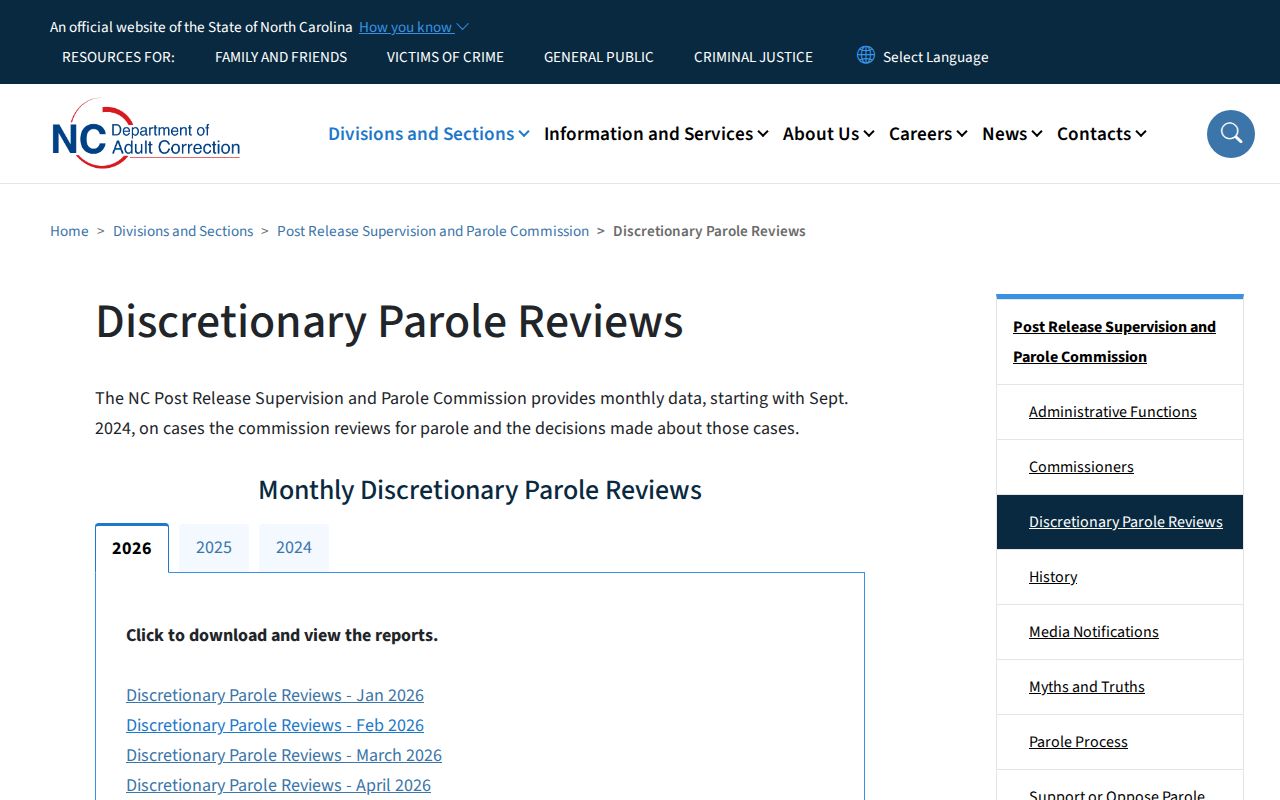
The image shows the publication route, not a decision about any particular person. Check the month, the listed outcome, and the DAC person record together.
Alamance Parole Eligibility Limits
Article 85, especially G.S. 15A-1371, governs parole eligibility for covered prisoners, including impaired-driving imprisonment and older-sentence provisions. It is unsafe to apply one “first eligibility” fraction to all cases. The statute in force for the offense controls.
When supervision ends, verify the discharge in the DAC record or obtain the existing agency record. A closed community episode is different from an expunged court case, and an online status change is not proof that every underlying record was destroyed. North Carolina records law also permits lawful limits for confidential, sealed, juvenile, medical, victim, and security information.
A public DAC history may retain a completed prison or supervision episode after the current status changes. That history helps separate four events that are often confused: release from jail, release from state prison, the start of community supervision, and final discharge. If the public display does not settle the sequence, request the existing offender or supervision record from DAC. An agency need not create a custom calculation or new narrative, but it can identify records already held under the offender number.
Note: A parole decision, a prison release, and the final discharge from supervision may occur on three different dates and require different records.