
Alamance State Prison Placement
The DAC prison facility directory does not identify a state prison in Alamance County. A person committed from the Alamance County Detention Center may be assigned to a prison elsewhere in North Carolina. Placement can later change within the statewide system. Neither the county of conviction nor a move between prisons proves that the person has been released.
The facility-map entry therefore represents the North Carolina prison system as a whole. It is not a hidden county institution and should not be described with the address, roster, or release practices of the Alamance jail. ACSO controls the county booking until transfer. DAC controls the state incarceration after admission.
| Custody event | Record owner | Meaning |
|---|---|---|
| Alamance jail departure to DAC | ACSO release/transfer record, then DAC admission | Custody continues under the state. |
| Move between state prisons | DAC | Placement changes, but state custody continues. |
| State prison release | DAC | Prison custody ends by the recorded release type. |
| PRS or parole after prison | DAC Community Supervision and the Commission | Physical prison custody ended, but supervision continues. |
| Final discharge | DAC | The applicable correctional episode ends. |
Search North Carolina Prison Records
DAC Offender Public Information covers people who have been in North Carolina prison or community supervision. DAC says the system’s history begins in 1972. It does not include everyone ever booked into an Alamance County jail. A short county-only detention episode may have no DAC record at all.
- Search by DAC offender number when available. It is the most precise key.
- If the number is unknown, search the exact last and first names, then compare age or birth information and conviction details.
- Open the full person record. Do not make the release decision from the results grid.
- Read current status, most recent incarceration, sentence records, projected or actual release fields, and community-supervision episodes together.
- Match the county of conviction and dates. An Alamance conviction can be served at a prison elsewhere in the state.
The official search screen provides the state record entry point. Open the current DAC offender search shown below.
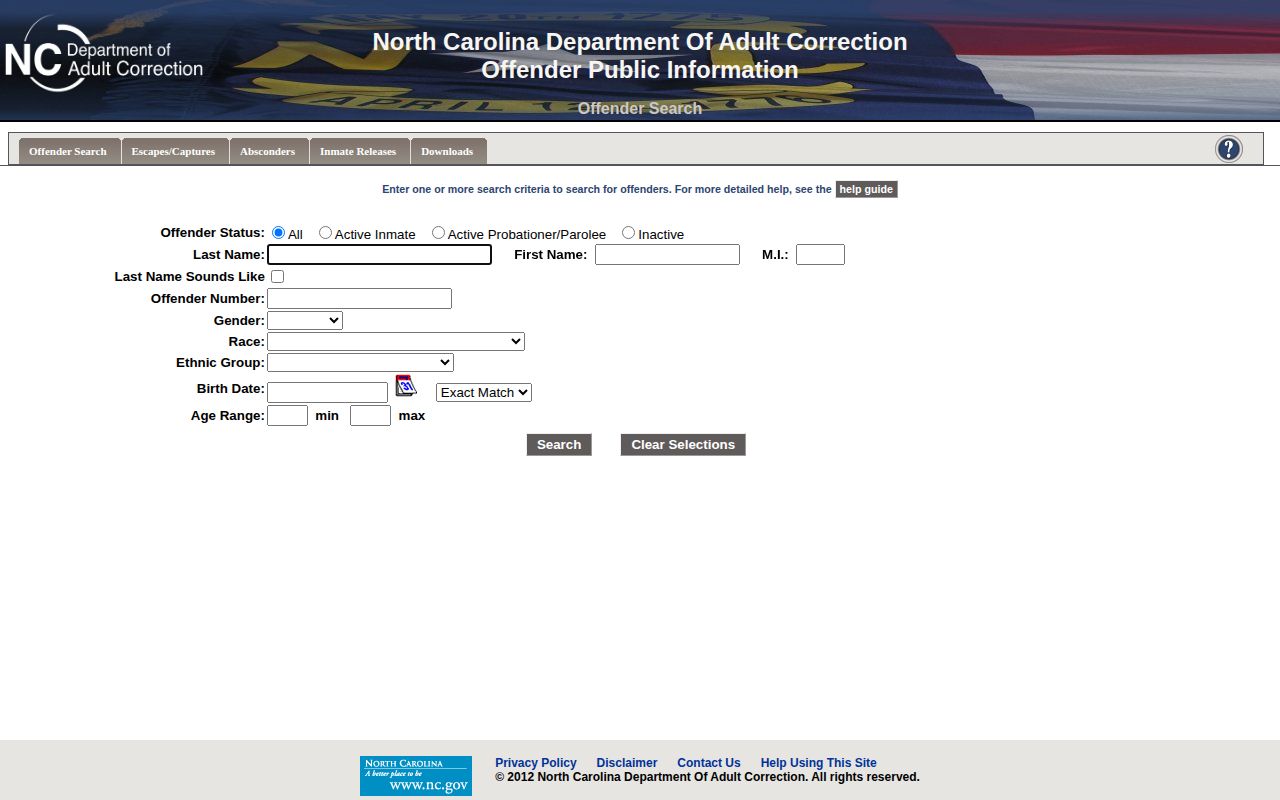
The legacy web address does not change the current agency name. Use North Carolina Department of Adult Correction or DAC, not the former DPS name, when requesting a release record.
North Carolina Prison Release Fields
A full DAC person page places a release date in sentence context. For someone already out of prison, inspect the latest incarceration summary and completed sentence history. A historical release remains valid even if the person later begins supervision, returns to custody, or receives another sentence.
| DAC field or record | What to check |
|---|---|
| Offender number | The stable identifier used to avoid a same-name match. |
| Current status | Whether the person is incarcerated, released, on probation, parole, PRS, or in another listed status. |
| Admission and sentence dates | When state custody and the controlling sentence began. |
| Minimum and maximum terms | The judicial sentence range used with credits and statutory release rules. |
| Projected Release Date | DAC’s current calculation for a person still incarcerated, not a promised exit time. |
| Actual release date and type | The completed prison-release event and its recorded category. |
| Community supervision | Probation, parole, or PRS activity that may follow or exist apart from prison release. |
Read three layers: custody now, sentence calculation, and historical event. A person can be released from prison yet remain on post-release supervision or parole. That is still a real prison release, but it is not the end of correctional supervision.
DAC Release Search for Alamance
DAC also provides an official Inmate Release Search. It can be queried by county plus year and month or by surname. Its result headers are Offender Number, Last Name, First Name, Middle Name, Release Date, Primary Offense (Qualifier), and Type Of Release.
Alamance is selectable, but the tool is a state-inmate release list organized by release county. It is not an Alamance County jail release list. The interface window observed during research offered 2024, 2025, and 2026. That was an interface observation on July 30, 2026, not a retention promise. Older person-level history may remain available in the main DAC record.
A DAC release result concerns the state prison system. Do not place current Alamance jail inmates or county-only releases into this state list.
When the list and person record differ, use the offender number to open the full record and ask DAC about the specific incarceration episode. The list is useful for discovery; the person record and agency-held release document provide the stronger episode history.
North Carolina Prison Projected Dates
DAC uses Projected Release Date, or PRD. For a PRS-eligible Structured Sentencing prisoner, the Commission manual describes PRD as the maximum imposed prison term minus the statutory post-release-supervision component, pretrial confinement credit, and earned time. The flat minimum release date is the minimum term minus pretrial confinement credit.
G.S. 15A-1340.13(d) permits earned time to reduce the maximum term but not below the minimum. DAC’s victim-support explanation says the offender serves 100 percent of the minimum sentence and ordered jail credit counts toward that minimum. North Carolina’s system must not be reduced to a generic 85-percent claim.
A PRD may change when confinement credit is corrected, earned time is awarded or lost, disciplinary events affect credits, consecutive or concurrent terms are resolved, a new sentence or detainer appears, a court order changes the judgment, PRS is revoked, or DAC corrects data. A transfer between state prisons does not by itself create a new release date.
North Carolina Prison Release Routes
State prison can end by expiration of sentence, release to post-release supervision, parole for an eligible sentence, a court-ordered release, pardon, commutation, or another defined route in DAC policy. The release type matters because it explains whether correctional supervision continues.
- Expiration or max out
- The sentence is fully served under the controlling calculation, with no parole or PRS reporting in the relevant policy definition.
- Post-release supervision
- A statutory community phase after release from many modern eligible felony terms.
- Parole
- Discretionary release for eligible older or otherwise preserved sentence groups.
- Court-ordered release
- A release required by a court order that changes or ends the legal basis for custody.
- Transfer
- A move to another custodian while confinement continues. It is not a community release.
North Carolina abolished ordinary parole for offenses committed under Structured Sentencing on or after October 1, 1994. Parole still matters for eligible older and preserved categories. Modern statutory PRS should not be called a parole grant.
Confirm a North Carolina Prison Release
For a completed state episode, save the DAC offender number and identify the incarceration period. Ask for the actual release date, release type, releasing facility record, and any public supervision-status record. Use DAC’s current public-records route, not an obsolete DPS form. The agency need not create a new calculation or answer a broad narrative question, so request existing records with exact identifiers.
North Carolina Department of Adult CorrectionState prison, release, and community-supervision records
DAC official website
Offender Public Information
Inmate Release Search
No DAC prison address belongs in an Alamance County contact card because no state prison was identified in the county. Use the statewide DAC route and the facility shown in the matched person record. For a prior county-jail transfer, ACSO can certify when its custody ended, while DAC certifies the state admission and later prison release.
After a North Carolina Prison Release
A prison release may begin PRS or parole. DAC Community Supervision administers probation, parole, and PRS, while the Post-Release Supervision and Parole Commission makes parole decisions and handles specified PRS actions. If the DAC record shows an Alamance supervision connection, use the official local lines at (336) 570-6840 and (336) 570-6847, then confirm the correct office through DAC’s directory.
NC SAVAN through VINELink can provide custody notifications from participating sources. It is timely corroboration, not a certified DAC release record. A no-result does not prove release, and a transfer alert does not prove return to the community.
Federal and immigration custody use separate systems. A person who leaves DAC for another authority may remain confined. Use the receiving-agency field and the appropriate BOP or ICE locator rather than treating “released from DAC” as freedom from every form of custody.