
Alamance Projected Versus Actual Release
North Carolina DAC uses the exact term Projected Release Date, often shortened to PRD. A projection reflects the sentence and credits entered at the time of the calculation. An actual release date records an event that has occurred. The two can match, but they serve different purposes. DAC release policy also uses “max out” for expiration of sentence in the relevant setting.
A pretrial detainee has not yet received an active sentence for the pending charge, so there is no sentence-based PRD to calculate. Bond, dismissal, a court order, transfer, or later judgment may control what happens next. A locally sentenced misdemeanant may have a term and credit calculation, but ACSO or the court must confirm it. State prisoners use DAC records and policy.
Choose the Alamance Release System
The first task is to identify who controls custody. The ACSO P2C current roster covers people displayed in the Alamance County detention system. DAC Offender Public Information covers state prison and community supervision. A person leaving the county jail for DAC has transferred; that is not release to the community.
| Situation | Correct date source | Key limit |
|---|---|---|
| Pretrial county detainee | Alamance court orders and ACSO custody confirmation | No sentence PRD exists for a pending charge. |
| Local active sentence | Judgment, confinement credit, and ACSO calculation | A public roster may not show the full computation. |
| North Carolina state prisoner | DAC person record and release policy | PRD may change before actual release. |
| Already released state prisoner | DAC completed incarceration and actual-release fields | PRS or parole may continue after prison. |
| Federal prisoner | BOP Inmate Locator | BOP release does not rule out another custodian. |
The full Alamance County released-inmate lookup explains how the sheriff, DAC, court, and federal records fit together. Do not ask ACSO to certify a later prison discharge that DAC controlled.
Find an Alamance Projected Release Date
Use a DAC offender number when it is known. It is more precise than a name. A name search requires careful matching by age or birth information and sentence details. Always open the full person record rather than stopping at the result grid.
- Determine whether the person is in Alamance County jail custody, state prison, or another system.
- For state prison, open DAC Offender Public Information and search the offender number or exact name.
- Match the person, then read current custody, sentence begin date, minimum and maximum terms, confinement history, and the field labeled Projected Release Date.
- For a local sentence, obtain the judgment and ordered jail credit from the Alamance court record, then ask the Detention Center to confirm its current release calculation.
- When the date is near, contact the controlling facility. After release, verify the actual event rather than preserving the PRD as if it were final.
The DAC search form shown here is the official state entry point. Review the live DAC offender search before entering a query.
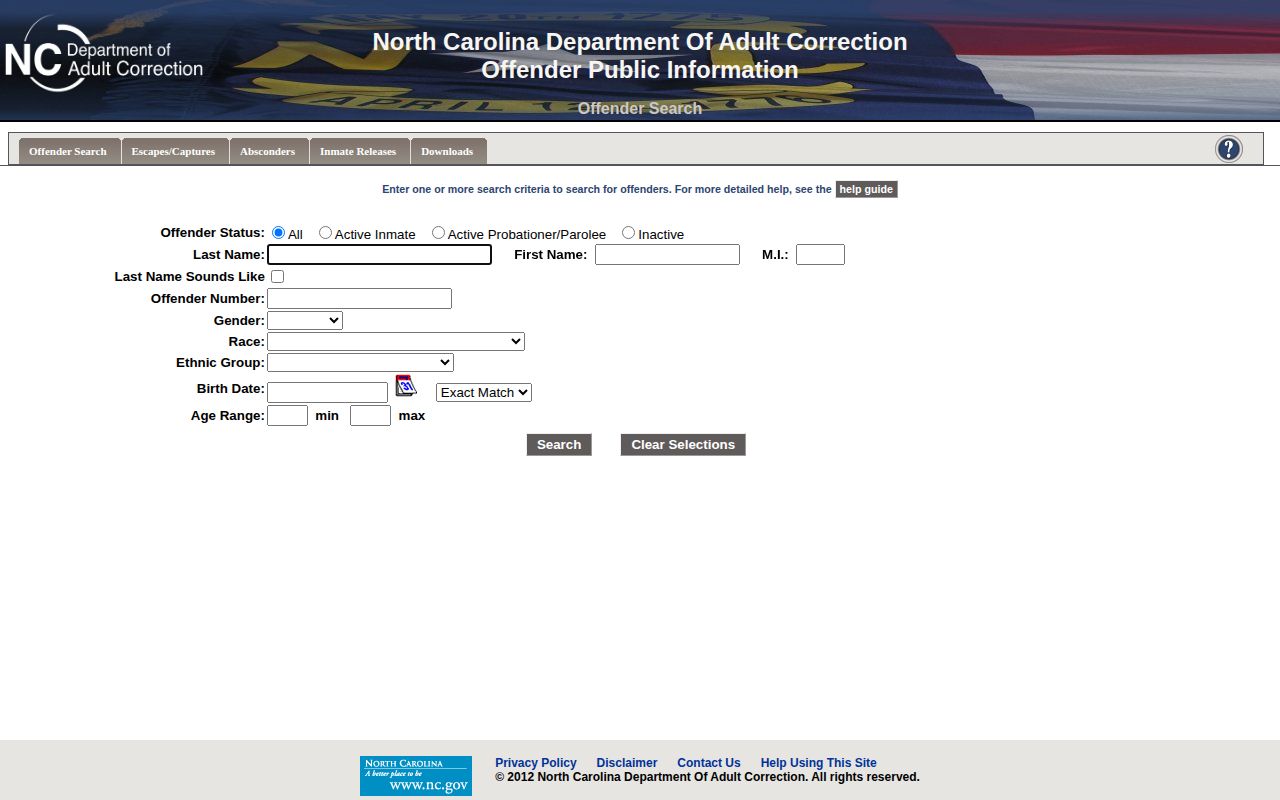
The search form finds state correctional records. It is not an Alamance County jail roster, and its legacy web address does not change the current agency name, North Carolina Department of Adult Correction.
How North Carolina PRD Works
For a PRS-eligible Structured Sentencing prisoner, the Commission manual describes PRD as the maximum imposed prison term minus the statutory post-release-supervision component, pretrial confinement credit, and earned time. The flat minimum release date is the minimum imposed term minus pretrial confinement credit. When PRD equals that flat minimum date, the manual says the person has accumulated the maximum possible earned time.
G.S. 15A-1340.13(d) permits earned time to reduce the maximum term but not below the minimum. G.S. 15A-1340.17 sets Structured Sentencing minimum and maximum terms. Article 84A establishes release to post-release supervision under the applicable formula. The law in force for the offense and judgment controls.
Ordered jail credit counts toward the minimum. Consecutive sentences, concurrent sentences, different offense classes, and the required PRS component all affect the calculation. A public date should never be rebuilt from a few isolated fields when the official record already supplies the current PRD.
No Alamance 85 Percent Rule
North Carolina’s state PRD is not a generic “everyone serves 85 percent” calculation. DAC’s victim-support explanation says the offender serves 100 percent of the minimum sentence and that ordered jail credit counts toward it. Earned time can move the maximum toward the minimum but cannot cut the prison term below that minimum under the Structured Sentencing rule.
The ratio between minimum, maximum, PRS, credits, and actual time is sentence-specific. Federal truth-in-sentencing discussions about 85 percent do not replace North Carolina’s statutes. Nor can one person’s ratio be copied to another sentence. The exact offense date, class, judgment, credit, and disciplinary record matter.
A different rule applies to activated misdemeanor sentences under local or DAC rules. G.S. 15A-1340.20(d) caps the combined earned-time award at four days per month of incarceration. That limit is not an 85 percent formula, and the jail custodian must confirm the actual local calculation.
Why Alamance Release Dates Change
A PRD is recalculated when the facts or legal inputs change. Some changes move the date; others explain why the expected release did not become a community release. A transfer between prisons alone does not establish a new release date.
| Change | Possible effect |
|---|---|
| Confinement credit entered or corrected | Adjusts the credited time applied to the sentence. |
| Earned time awarded, forfeited, or restored | Moves the maximum-term calculation within the legal floor. |
| Disciplinary event | May change earned-time treatment under applicable rules. |
| Consecutive or concurrent terms resolved | Changes how multiple sentences combine. |
| New sentence or detainer | May prevent community release even if one term ends. |
| Appellate or trial-court order | Can change the judgment, credit, or authority for custody. |
| PRS revocation | Can return a previously released person to custody. |
| Agency data correction | Updates the public PRD without a new court event. |
Note: A custody-review date is not automatically a parole review or a projected release date; use the exact label in the DAC record.
Alamance Jail Earned Time
G.S. 15A-1355 addresses term calculation and earned credit. G.S. 148-13 directs DAC to adopt credit rules and provides that relevant regulations are distributed to local jail administrators for sentenced jail prisoners. The public should not use a private calculator as a substitute for ACSO’s current record.
Ask for the sentence start, ordered jail credit, local earned-time treatment, and any other public factor the custodian used. The court judgment states the sentence, while the jail applies custody and credit data in its system. If the records differ, use the case number and booking number to ask each office about the field it owns.
G.S. 148-13(a) also authorizes DAC rules for cash and clothing on discharge or parole and says cash awarded after incarceration of two years or more must be at least $45. This is a state-prison discharge rule. It is not a promise that Alamance County jail provides “gate money.”
Confirm the Alamance Release Day
No published ACSO rule was located that promises a particular release hour or a weekend or holiday shortcut. Do not assume a Sunday date becomes Friday, tell a family to arrive at midnight, or treat the displayed PRD as pickup instructions. Call the Alamance County Detention Center at (336) 570-6317 with the booking number and ask what can be confirmed.
For a state prison date, DAC policy and the holding facility control processing. A pending alert through NC SAVAN and VINELink can provide notice of a transmitted custody change, but the alert remains a secondary source. Confirm the actual release date and type in the DAC record or with DAC.
After release, distinguish prison exit from the end of supervision. PRS or parole can begin when physical prison custody ends. A later discharge date may mark the end of that community episode. These are valid but different milestones.
Record the Alamance Actual Release
Once the event occurs, replace the working projection with the actual-release evidence. A DAC completed incarceration can show the release date and type along with the sentence history. An Alamance County jail release should be confirmed through ACSO’s existing booking and release record. The court record can supply the judgment, dismissal, bond order, or other legal authority, but it may not show the minute physical processing ended.
Keep the booking number or DAC offender number with the record. Ask whether the person left for the community or another authority. A receiving agency, detainer, or new sentence can explain why an expected release date did not mean freedom from custody. If a later violation returns the person to custody, preserve both events: the earlier actual release remains true, while the new episode establishes current status.